
Last week we got into a little detail about how important it is to get a fitting for the right shaft model to match your very unique combination of swing mechanics. Today I want to expand on that, maybe even compare a few more different shafts and get into more detail about what makes them so different, and just how hard it can be to compare them on paper even with all the info you can find online for the shafts. One of the questions I get a lot when I’m logged into my chat job answering fitting and customer service questions, is something along the lines of our title up there. “I play a Ping G430 with the stock Alta shaft, what shaft do you have that is most similar for me?” or “I play the HZRDUS Smoke Yellow 60 but I don’t see that on the list, which is most similar to that for the drivers?” I’ll just put this out there right now, the short answer is that I can’t tell you that, anyone who tells you they can look up exactly what that is without seeing you hit the shaft is lying to you. Even if you tell me your exact swing speed, ball speed, angle of attack, effective loft at impact, swing direction, face angles, and your launch, landing angles and spin rates with an exact head and shaft, I still can’t tell you what other shaft is most similar. You have to hit the shaft to find out if it is more similar than another that is very similar on paper, or against ones that might not be the exact same on paper, almost any could perform the same in your swing. The simple fact is that there are things in your swing that can’t be picked up by launch monitors, things that only hitting a shaft can tell you about how it will perform for you. Not only that, but there is just not enough information on paper, not the same information from each company, nor is it all measured the same by each manufacturer, so you could be comparing numbers that don’t even really match. Let me go into more detail about what I mean by that.
Now generally there are only a few ways you can measure a golf shaft, and one of those, being the length of the shaft, has never really been used by anyone to try to tell you anything about the shaft’s performance. The other ways most commonly used to differentiate shafts from one another are things like the weight, kick point, tip stiffness and torque. Some will even break down the shaft by sections, outlining the stiffness of the butt, mid-section, and tip of the shaft, and may even advertise a spin or launch. Let’s just go through a quick exercise where we try to compare a few different shafts on paper using the info from each of their respective websites, I’ll show you what I mean:
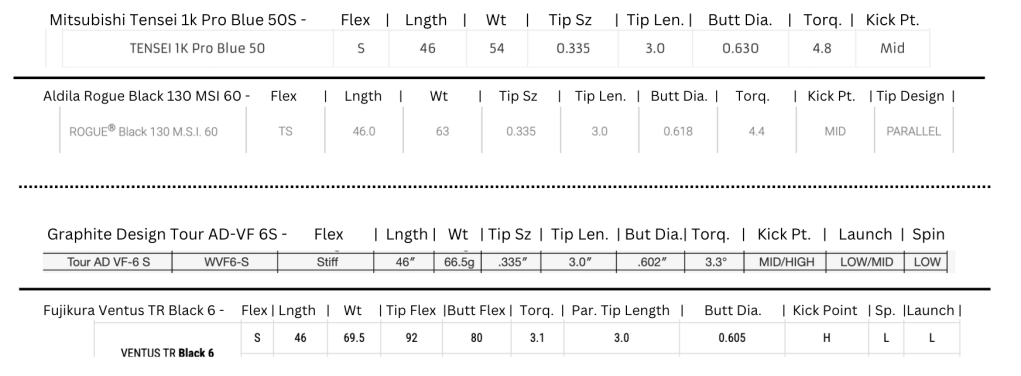
These are all screenshots of all the specs online that you can see for the 4 shafts I have listed above in the picture there. First and foremost, what I’m sure you’ll notice is none of these are the same. All of these companies measure their shafts in different manners, use different ways to illustrate the performance of their shafts, measure different parts of their shafts in different ways, using different measuring scales, techniques and conversions. I’m not going in to the definition of torque, what tip stiffness versus butt stiffness does for a golf shaft, things like that will come in future articles. What this is meant to demonstrate is just how difficult it can be comparing shafts online, the only thing you can really do with any confidence is compare shafts of the same manufacturer, and really only if you know exactly how you hit one of their shafts that they also have the specs for. If you only want to do a fitting with one single shaft manufacturer, you are severely hindering yourself and the improvements you can make to your golf equipment should that manufacturer not have a shaft that just so happens to fit absolutely perfectly. In a vacuum, there are no shafts that are used by major club manufacturers that are miles better or worse than the rest. All of this is wholly dependent on your very unique swing mechanics, there is nothing saying that Dumina AutoFlex, Graphite Design or Fujikura Ventus (three very common “premium” shaft upgrade options) have better shafts for your swing than Mitsubishi or Project X. There’s nothing saying KBS will always have an option better for your irons if you’ve already been properly fit for a standard no up-charge shaft. All of that to just reiterate that if you have to limit yourself to just one manufacturer by only comparing them online, you are truly not able to get a proper guaranteed fit with the shaft that is the single best for your swing motion.
And finally, even comparing shafts to one another when they have the same perceived metrics, what does that tell you? Let’s just use our shafts in our picture up there again, looking at the Tensei versus the Rogue, both have a “Mid” kick point. The Kick Point generally tells you a rough idea of the launch angle that a shaft will influence. The lower the kick point, generally the higher that shaft will launch the ball, so a “low-kick” shaft has a bending point much lower in the shaft, and will want to launch the ball higher as a result, and vice versa for a “high-kick” shaft option. But where exactly is “mid” kick? We have a shaft from Aldila versus a shaft from Mitsubishi, are those mid-kick positions the same on each shaft? They are not, or honestly maybe they could be, but the short answer is we don’t know because there is no industry standard, there is no governing body to step in and say ‘this is exactly how everyone has to measure their shafts, these are the specs they have to advertise and the way they have to measure and advertise them.’ However, having said all of that, there is one very simple solution to all of these issues that you can have when trying to compare your shafts online:
DON’T TRY TO FIT YOURSELF FOR A GOLF SHAFT ONLINE. THE ONLY WAY TO COMPARE GOLF SHAFTS FROM VARIOUS MANUFACTURERS IS TO ACTUALLY HIT THEM WITH YOUR VERY UNIQUE SWING MOTION.
There is not a soul on this earth that can tell you what shaft you should be playing in your golf clubs without watching you hit them. There is not a fitting that you can take online, there are no fitting tools on any manufacturer’s website, there are no written tests that you can take that can tell you, out of all the almost hundreds of shaft options out there, which exact one will fit your swing the best. The only thing that can tell you is your actual golf swing and hitting those shafts, the only way to do that is with a proper fitting in person. Please go get a fitting the next time you need new golf clubs, and if the fitting location you’re looking into doesn’t offer a free fitting with the cost of the clubs, move on to the next one until you find one that does. Most of us at least have one 2nd Swing location somewhat near us, worst comes to worst their locations will always have that option, both for new and used golf clubs to boot!

 Green Grass Golf Shop
Leave a comment