
Back again with more compression talk, this is a topic I will speak a lot on, at least until I stop getting this question…so I’ll probably never stop. This is a question that I get quite often, and one of the most common misconceptions that I’ve come across working in the golf industry, that your swing speed alone should dictate your golf ball selection. The idea that the slower you swing the club, the softer your golf ball needs to be for peak performance is one of the most prevalent myths in the game of golf and hasn’t had any basis in fact for some decades. This idea comes from ancient times (for those of us born in the 90’s, that just means before the 90’s) when all golf balls had wound twine or even liquid cores, when they were made from granite, chiseled with the very first stone tools of the disco era. Back in those days, compression mattered for a few reasons. First of all, because the manufacturing process isn’t what it is today, balls weren’t produced nor were they inspected or tested with the same rigor or technology with which we test or produce modern balls. Because of that you could have compression ratings that varied wildly from ball to ball even in the same box of 12 golf balls you just bought in the shop. On top of that, it was incredibly difficult to compress some of these twine and frozen liquid cores, to the point that you needed to sell and purchase your balls almost based on compression alone. Ladies played 80 compression balls, men played 90 and above, and that was that, but that hasn’t been the case for many-a-decade. This myth still holds on from golf professionals who don’t care to keep themselves educated, instructors and fitters and golfers alike that hold on to those ideas and either don’t believe, or refuse to learn how the modern materials change those. Those are passed along to their students, their playing partners, their children, and on and on. And once a golf pro says it one time, it’s gospel and a stone cold fact for the rest of their lives. On top of that, you have manufacturers that aren’t Titleist still playing on those misconceptions to sell balls to an unsuspecting public, trying to keep up with the #1 Ball in the Game. That last fact is the one that bothers me the most, if you can’t make a ball that’s as good as the ProV1 I suppose you need to resort to slimy advertising tactics like selling balls by compression rating, but I’m here to tell you that is far from necessary for modern golf balls for so many reasons.
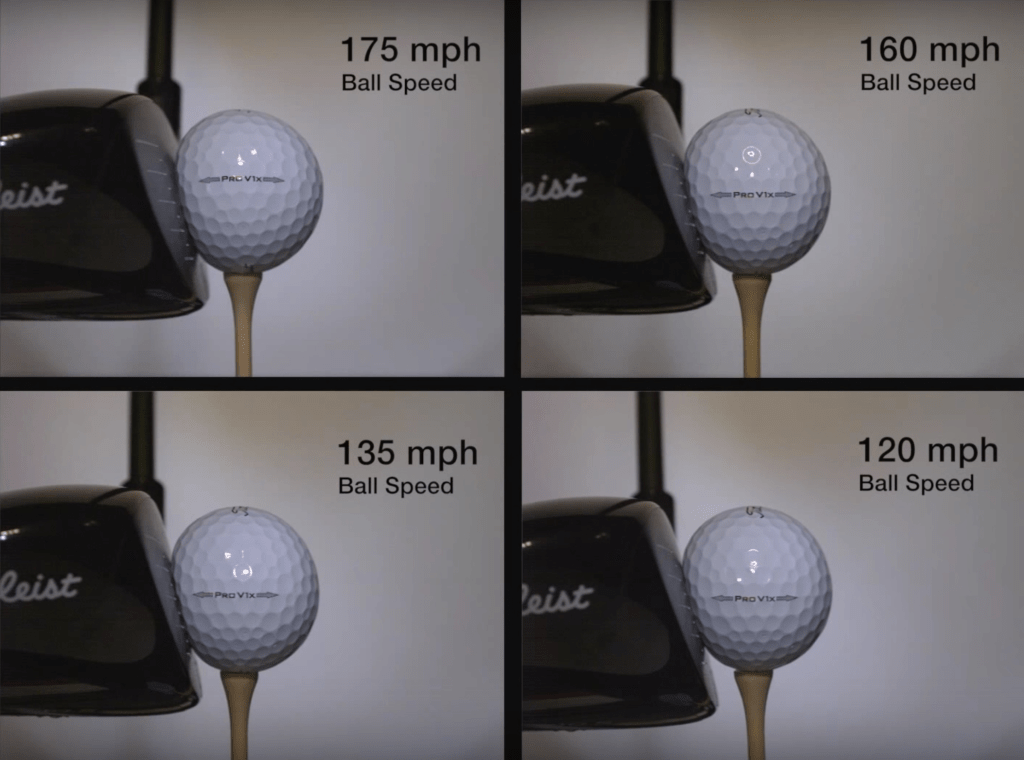
The first reason is the construction process of the golf ball and the materials that are used. Long gone are the days of balata covers and twine cores that needed to be sold by compression, that had different compression ratings ball to ball within the same dozen. These days golf balls are made with proprietary rubber composites designed to compress no matter your swing speed. They are covered with Urethane composites you can make as thin as paper, soft as a Miami Dolphin looks in his teal uniform (that’s very soft), and as durable as Kevlar. Golf balls are made with materials designed to compress and spin no matter your swing speed. I promise if I can compress a ProV1x with my 15mph chip shot swing and get it to check on the green (more than I want it to half the time…), you can do the same with every club in your bag, no matter your swing speed. You can even see in the picture in this blog here, you don’t need to create a ton of ball speed to be able to squish a ball like everyone wants to do, you get the same compression from Tour Level ball speeds that you get from the average golfer’s. That ball in the picture, the ProV1x, has always been, and still is, one of the more firm models on the market. Now with that being the case, the only thing that you have to worry about with your compression these days is the opposite of what was always taught. With how easy it is to compress a golf ball, the only players needing to worry about compression are those with incredibly fast swing speeds, as those can compress the softer balls too much, leading to much less distance and control. No matter your swing speed, the more firm a ball is at its core, generally the more ball speed it can produce. Think about one of those rubber balls you got from the quarter machines outside the grocery store, the harder you throw and bounce them, the further they go, right? You ever hit one of those with a baseball bat or a tennis racquet? They go for absolute miles. Now compare that to a tennis ball, that’s not going nearly as far or as fast right? Think about how much more that tennis ball will squish and compress, in doing to it disperses much more energy away from the surface that it’s striking. The same will be true for a softer ball versus a more firm model, the core of the more firm ball will always bounce more of the potential energy directly back off of the clubface and produce much more ball speed, and a softer ball will always disperse more energy away from producing that ball speed (I’m clearly not a physicist, Bill Nye please help). No matter your swing speed, softer balls will always produce less ball speed.
They will also produce much less spin, for a reason I’m about to explain if you just hold your damn horses, jeez. The way spin is produced by the modern golf ball is by having a softer layer covering one that is much more firm, because science (look it up, it just works). With the construction of the super soft balls being typically 2 pieces, that just isn’t possible with such a large, soft core. You can’t have a super soft layer outside of the super soft core, at least not one that is softer than the core, therefore the softer the ball, generally the less that it will spin for you. And just very quickly the launch that a ball produces has absolutely nothing to do with the compression at all. The way a golf ball launches is solely determined by the dimple pattern of the golf ball, and the way those interact with the wind resistance created by traveling through the air at such high speeds. You will typically find that most manufacturers (generally those who aren’t Titleist as we touched on earlier) produce softer balls specifically for slower swing speed players. So, for the most part, they will also have dimple patterns on those softer balls that produce a higher launch, but no matter how high the launch is that dimple pattern can produce, the softer ball construction can’t produce the spin that those slower swing speeds often need. Because spin as we know isn’t just produced by a golf ball, it’s also highly influenced by your swing speed. Having a more firm and higher spinning ball can really help make up the difference for those slower swing speed players who may have trouble producing that spin on their own.
So, who are softer balls made for then, what is the point of the softer balls if they always produce less ball speed and spin? Honestly, in my humble but still professional opinion, they are made for players who will never be able to properly compress a golf ball no matter how firm it is. For players whose swing does not, will not compress a ball with the way they deliver the club to the ball, how far their hands are behind the ball at impact, among a lot of other mechanical factors, and will never get a lesson to correct that. They are also typically a good deal lower on the price tag than more firm models, being lower spinning as well they can be very good for a player who may lose a lot of balls during their round. Not only the obvious piece of that, losing cheaper balls is much easier on the wallet, but the slower ball speeds and lower spin rates can even potentially keep a few more balls just in play instead of rolling just into the weeds and disappearing forever. Slower and lower spinning balls are a little harder to lose than a super high flying, high spinning and lightning fast ball like a ProV1x. And finally, just personal preference, some just like the feel of a softer ball, no matter the performance of the ball, and aren’t really consistent enough to notice the subtle differences between a Chrome Soft and Supersoft, and that’s fine, too! Long story short, there is a ball out there for everyone, every ball model can be good for a certain style of player with their personal preferences. However, if you are looking for a ball to go the furthest, spin the most around the green, like most players are looking for, a more firm model is always the way to go. The slower your swing speed, the more you can benefit from a more firm ball model that produces higher ball speeds and spin rates. And finally, anyone trying to recommend a ball based solely on compression and swing speed is trying to sell you something, regardless of whether it will be the best for your game or not.

 Green Grass Golf Shop
Leave a comment