
What on earth is “bounce,” and why is it important to your game? First and foremost, if you only read this far, bounce is your friend and every amateur golfer should be utilizing their bounce on their clubs better. That’s not to say that everyone needs more bounce on their wedges, that simply means that your “square” club face should be at a minimum 1 degree open from square. That will make sure the bounce is exposed and the first thing making contact with the ground, rather than your sharp leading edge of your wedge at the bottom of your club face, and will make the club much more forgiving. Bob Vokey, the designer of one of the greatest wedges throughout the modern game, has hosted many seminars for golf professionals and (jokingly) said something to the effect of the following, “Picture yourself at your next wedge lesson, your student has a Vokey wedge and they set up with the face square or even closed. You have my permission to take that wedge and whack them with it, that’s now how wedges are designed to be played!” Now like I mentioned, that was obviously a joke, but I can’t say for certain that everyone took it that way so be very careful at your next wedge lesson…. (‘So what is bounce, anyway, you still haven’t told us…’) Well, as the great Iggy Azalea once said, “Shake it, Break it, Make it Bounce.” (banger) That doesn’t mean anything in context to this article, I just like shoehorning dated pop culture references where they don’t belong. Wedges these days fall into 4 categories as far as bounce angles, as I see it: Low bounce is 8 degrees or fewer, Low-Mid is 9-10 degrees, High-Mid is 11-12 degrees, High bounce is anything 13 degrees or higher. The bounce angle of your wedge is that little second number, and that illustrates the angle that’s created by the leading edge of your wedge, and where it makes contact with the turf when in the square position. (see image below)
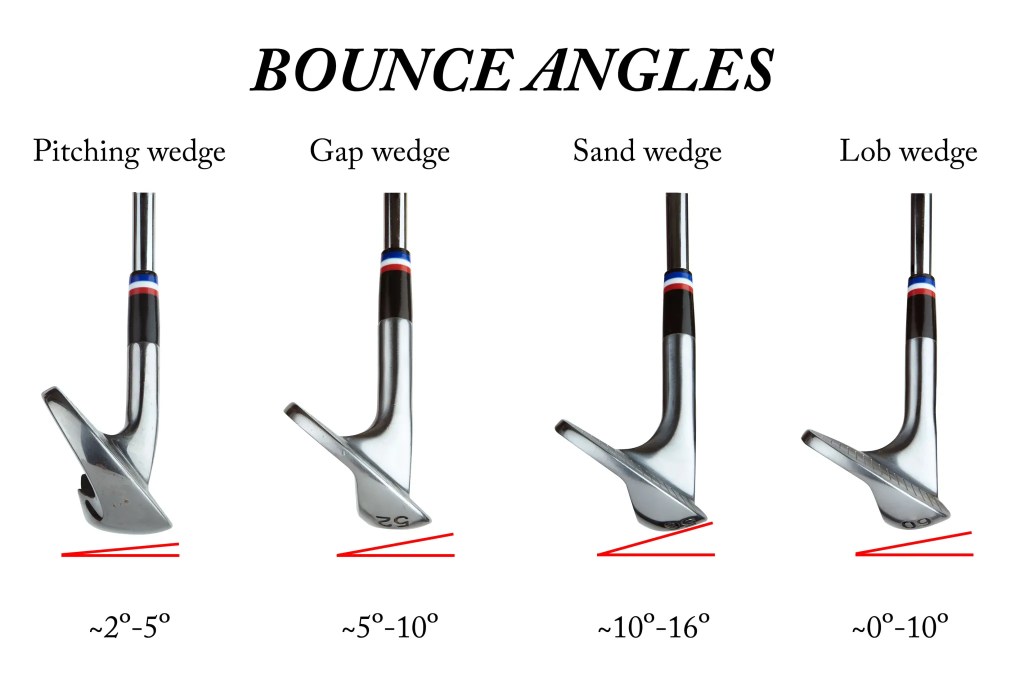
THIS PICTURE IS NOT A GUIDE FOR HOW MUCH BOUNCE EVERYONE NEEDS TO HAVE ON THEIR WEDGES! As I’ll explain throughout the article here, bounce angles should not be determined by anyone online who doesn’t understand your game, or any guides like that, there is no set standard for wedge bounce. Your bounce angles need to be determined by your unique combination of your swing mechanics, the shots you take on the course, and your typical turf and bunker conditions. Let me explain a little more on what I mean by that one by one, starting with your swing mechanics.
In layman’s terms, bounce is aptly named (and seemingly the only thing in golf that makes common sense), meaning the higher bounce angle you have on your wedge, the more it will effectively want to ‘bounce’ off the turf. Another way to think about that is the lower the bounce, the easier it will be for that club to grab the turf and start descending into the earth to take a divot. This means essentially that the lower the bounce angle of your wedges, the more penalty you will take if you don’t make a perfect strike on your shot hitting the ball right before the ground. This is why when we’re fitting for wedges, knowing how deep you take your divots on your full swings and around the green is absolutely essential. Generally speaking the more shallow your divot, or the less turf you take with your swings, the less bounce you generally need with your more shallow downswing. The deeper divots you take, the steeper your swing down into the ball, and the more you could benefit from a little higher bounce angle on your wedges.
The same will go for playing on softer conditions, playing a lot in the rain or soggy turf, or where it’s easier to take a divot. The softer your turf conditions, NOT THE GRASS YOU PLAY ON, the higher bounce you need. When we start talking about the unique grasses you play on, that means getting into grinds, leading and trailing edge relief, toe and heel relief, and that is a long conversation for another day. Not to mention the fact that those conversations are not necessary to fit you properly for wedges. Contrary to what I’ve said in the past, wedge fitting for bounce and grind can be done much more comprehensively online than other parts of the bag. We don’t need your swing speed, angle of attack, spin rates or apexes to fit you for turf interaction, your iron shafts will work just as well in your wedges as they do in your irons, so for most a fitting in person isn’t entirely necessary. So again, the softer the turf you play, the more you will benefit from that bounce, and vice versa for a player on more firm conditions where it’s more difficult to take a divot. The same can be said for the grinds you encounter in wedge fitting, the wider the sole of your wedge, regardless of the bounce angle, the harder it can be to take a divot, and vice versa for more narrow soled wedges. When we say wider soles, think of most traditional higher lofted wedges you’ve seen, 56 to 60+ degrees with a large area on the bottom of the club making contact with the turf. Then we also have a more narrow grind, that would look closer to the bottom of an iron, most of your PW and GW lofts in that 46 to 52 degree range will generally have a grind like that.
Finally, the last part of wedge fitting, for some players the most important part, the shots you are going to be taking with your wedge. I very highly recommend against such things, but there are players who still use their SW exclusively out of the bunker, nowhere else on the course, and no other clubs touch sand. For that player, you obviously don’t need to take into account your turf conditions or divot pattern for your SW fitting, so knowing what the wedge will be used for is incredibly important. Most players these days will use all of their wedges in a more all-around fashion, from full swings to 1/2 and 3/4 shots, pitches, chips and even long bunker shots, which is how I recommend you use them as well. If you have a 50 yard bunker shot into the green, it’s much, much easier to take that shot with the same swing you take out of a greenside bunker and a GW, PW or even a 9i. So for most players, getting the full picture of your turf AND sand conditions, divot pattern, your game and how you will use the clubs are all equally important. If you want to use your 60 degree exclusively for flop shots, but you play in swampy conditions and take absolute pelts for divots, a full sole that typically is needed for soggy turf and deep divots is impossible to take a full flop with, so you need trailing edge relief on a high bounce wedge. With bounce being tied into forgiveness as well, knowing how you miss your shots is very important. If you have trouble with thinning your wedge shots, obviously a higher bounce is not going to help that when you don’t touch the turf anyway. If you struggle with fatting your chips, hitting way behind the ball and digging into the turf, no matter what your turf conditions a higher bounce is always going to be better. However for most, for players using their wedges all around, how you should be using your wedges in my opinion, and without one single typical big miss with their chips, the equation can be pretty simple. Someone playing on softer turf and taking deeper divots will need a higher bounce, more full sole on their wedges. Those who play on softer turf and take very little divots, a higher mid-bounce and a more narrow sole, or one with more relief around the edges is most appropriate. Players who are normally on more firm conditions but still manage to take a deeper divot need something with a lower mid-bounce, but a more full sole will generally be the recommendation. Those who play on firm turf, and take very little divot even in softer conditions, will play best with a lower bounce and a sole/grind with a more narrow sole or lots of edge relief.

 Green Grass Golf Shop
Leave a comment