
Drive for show, putt for dough. We’ve all heard that phrase, at least most golfers have, but what does it really mean? The putter is the most important club in your golf bag, it’s the only club you are guaranteed to use every single hole (unless you hole out from off the green which, I mean, come on dude be honest). When you break it down stroke by stroke, you generally are taking almost 50% of your golf shots on the putting green rolling the rock. While I do think it’s been getting a little better in recent years, the idea of folks jumping at the newest $600 driver but scoffing at the idea of a $300 putter has always baffled me. I understand that hitting longer, straighter drives is more appealing on the surface than hooping more putts (just don’t tell that to Kevin Kisner). Having said that, I’ve always thought breaking 80 was way sexier than hitting over 300 yards (because I can do both? Don’t freaking judge me I’m allowed to brag sometimes). I’d much rather take someone’s money by scoring better than they do than I would out-drive them (but again, I can usually do both…stop looking at me like that!). I also understand that draining more putts is much more beneficial to your score than hitting more fairways. But how do you know what putter is right for you, what’s the difference between all these different shapes and lengths and where do I even start?
I’ll never stop banging this drum, the best place to start and finish if you have the resources is with a fitting in person. Especially finding a local golf pro or fitting center with a “SAM Putt Lab” or something similar they use to help them measure your mechanics and fit you for a putter. Essentially a SAM Lab is your Trackman for putting, with laser measured face/shaft angles, hand position, shaft lean, face position, point of contact on the putter, loft at impact, and all the important measurements like that. If you can find a local fitter with a SAM, you can just skip the rest of this article and make your appointment there, thanks for reading! However if you are like a lot out there that don’t have that access, there are a lot of things to understand about putters before going out to make a purchase. The first and simplest is the size of the putter. Putting is just a combination of speed and direction, rolling the golf ball in a certain direction at a certain speed. The most important of those by a wide margin is your speed control. Most of the courses we mere mortals play don’t have 5-10+ feet of break to read, and most golfers who aren’t just getting started at least loosely understand how to read a green. It’s much, MUCH easier to hit a putt 5-10 feet too long or too short than it is to misread or mis-hit a putt 5-10 feet right or left, controlling your speed is SO MUCH more important than your directional control. You can even still make a lot of putts with slight misreads, then slight mis-hits back on to the correct line if you have the right speed, something that happens much more often than you realize when you hoop a long one. You cannot, however, make nearly as many putts by running them 10 feet by, and (I’m not sure if you know this…) it’s impossible to make a putt if you leave it even 1″ short. The size of your putter can help immensely with your distance and speed control with your putter. Mishitting your putter even a fraction off of the center can greatly impact the speed produced by that stroke, but you will generally find less and less impact on speed the larger your putter head gets. You’ll find with most manufacturers and putters out there that the larger the putter head, the further back that brings the Center of Gravity (CG), and the greater the stability and more forgiveness it will have.
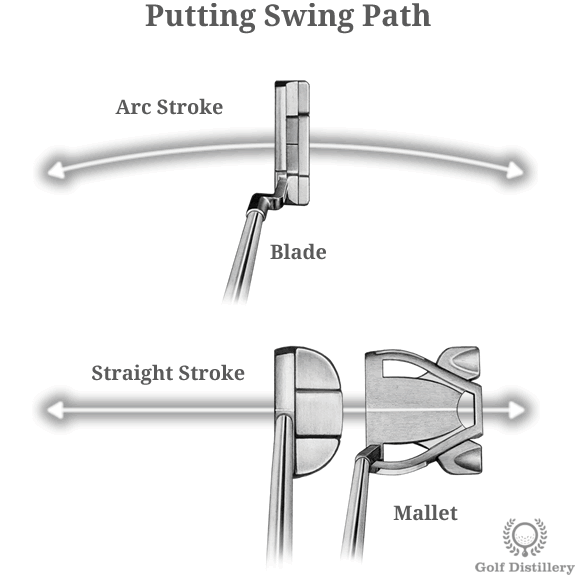
The next thing you can do to help you narrow down your putter selection is to determine the shape of your stroke, check out the image to the right. Whether you try to take the putter head straight back and through, you naturally follow the gentle arc around your body, or you take the putter inside on a sharper arc around your body is very important to the fitting process. Determining how much “toe hang” or “toe flow” or what level of face balance you need with the shape of your stroke is not possible to do perfectly on your own, but narrowing down the putters that would likely work better for you than others is actually pretty easy to explain (though not without a high word count…).
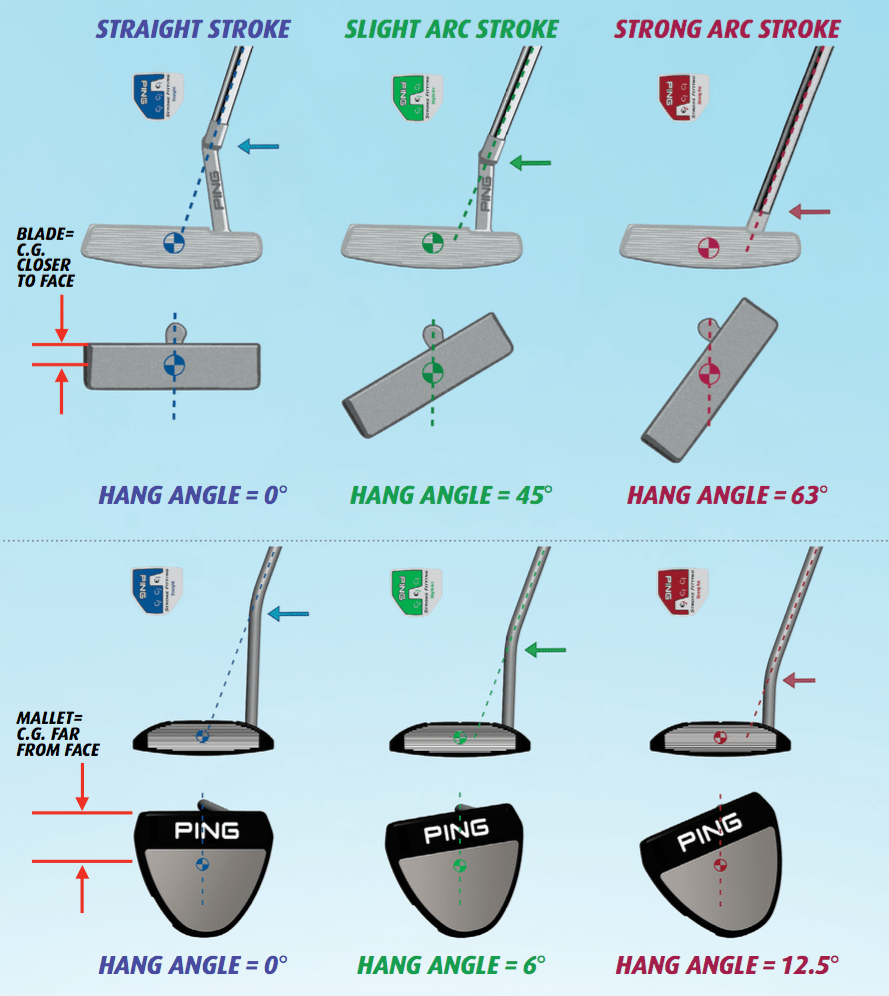
Ping has a great graphic that I’ll put in after this paragraph here to illustrate what I’m about to go over. Both the shape of the head, and especially the angle at which the golf shaft enters the head in reference to the center of the face, determines how much face balance or toe hang a putter will have. Generally the more your stroke arcs when you make a putt, the more toe hang or toe flow you need, whereas a straight back and through stroke will generally work better with a more face balanced design. As you can see below here, when looking at the putter face-on, meaning looking at the putter face itself, the angle the shaft goes into the putter head will determine how it is balanced. The closer to the sweet spot of the putter the bulk of the shaft angles into the head, the more face balanced that putter will be (see image below). The further that shaft angle moves to the heel of the putter, the more that toe will flow, the more it will work for arcing strokes that need the face to naturally open and close more through the stroke. You can also see how the size of the head changes that toe hang. Generally you won’t find many blade putters that aren’t center shafted or with odd acute angle plumber’s necks like you see in the top left image there that are face balanced. As you can see with the image as well (ASIDE FROM CENTER SHAFTED DESIGNS) it’s pretty easy to see the higher the bend in the shaft away from the putter head, or the longer the neck of the putter, the more that will send the shaft away from the toe and toward the center, creating more face balance. So simply put, the less your stroke arcs, the higher you probably want that bend in the putter shaft, and the larger you want your putter head to be.
Finally the length of the putter, this is certainly the most complicated to determine without seeing a fitter in person, but one you can manage with a little geometry. The difficult part comes in the fact you can’t do this with a simple wrist to ground measurement, you need to measure in your natural putting stance. Each player is going to bend over differently, hang their arms in different ways, so your wrist to ground when you’re standing still doesn’t perfectly translate to the same wrist to ground in your putting stance for each different player. So you may need an extra hand to help with your measurements, but you can actually use something you learned in 8th grade math (who knew, right?) to help figure out your proper putter length. Take a look at the image below if you need a refresher:
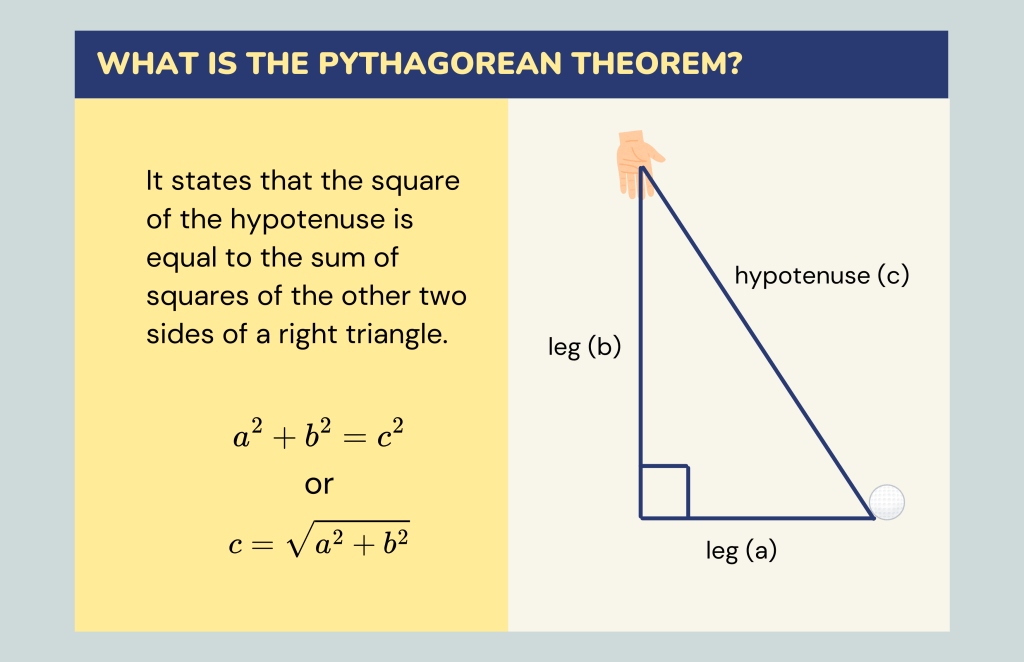
So first you need to determine (or get help measuring, rather) your wrist to ground measurement in your natural putting stance (leg (b)). Then the measurement from that point on the ground directly under your hands to the golf ball (leg (a)), you can use old Pythagoras’ work to calculate the proper length of your putter (hypotenuse (c)). Let’s just go over a quick example, say your wrist to ground in your putting stance is 31″ and from that point on the ground to the ball is 12″, here’s a step by step on the calculations…
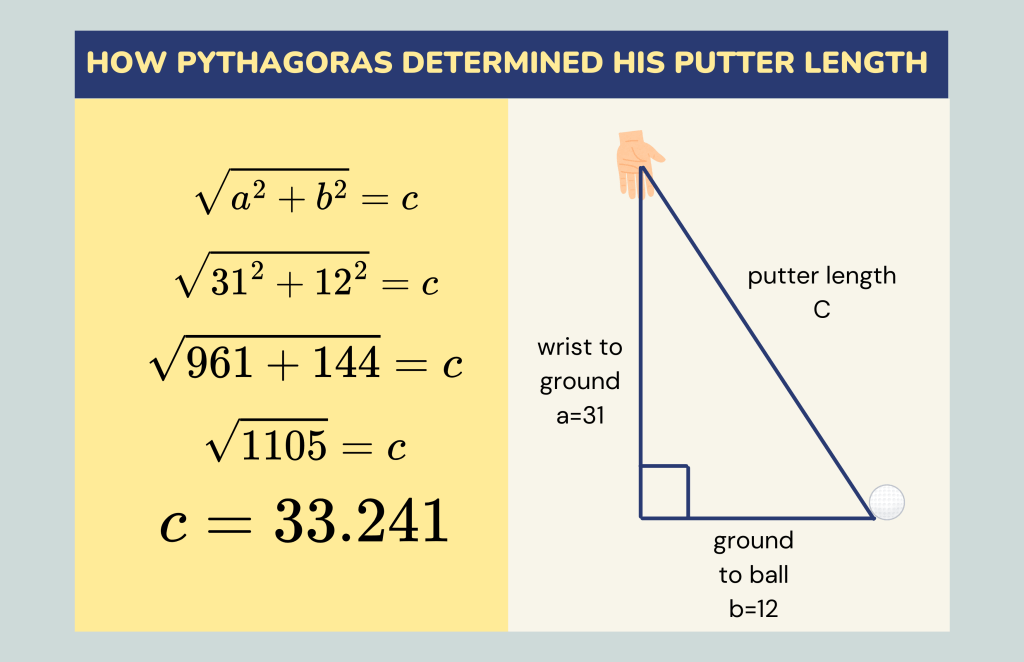
And if you’re lucky enough to have an exact 31″ wrist to ground and 12″ ground to ball, there are your calculations, your putter length should be right around 33.25″. THIS IS NOT AN EXACT CALCULATION BY ANY MEANS! This does not help you determine your ideal lie angle, your ideal loft for your stroke to get a consistent roll putt to putt. The one thing I didn’t go over, being the lines and angles created by different alignment aids and putter shapes, can be very important for a putter fitting, too. Only you can determine with your unique vision pattern which combination of angles, lines and dots (or whatever is on the putter to aid in alignment) help you line up the putter head the most consistently. That is where actually getting out and testing different putters in a golf shop can help a ton even if it’s not a full fitting. This calculation is also clearly not complete, you can’t order a putter at 33.241″ or 34.402″ so you’ll need to do some rounding, and some lie angle adjusting to make sure your putter sits flat at that length. However, if you don’t have the means or locations near you to pay for a proper putter fitting, if you are on a time crunch and need to buy something off the rack for a quick replacement, you can at least use these tips and measurements to give yourself a better chance of getting something that works. As long as you can properly calculate those measurements, determine the rough shape to your stroke and how consistent you are hitting the sweet spot of your putter, you can give yourself a pretty good fit.


 Green Grass Golf Shop
Leave a comment