
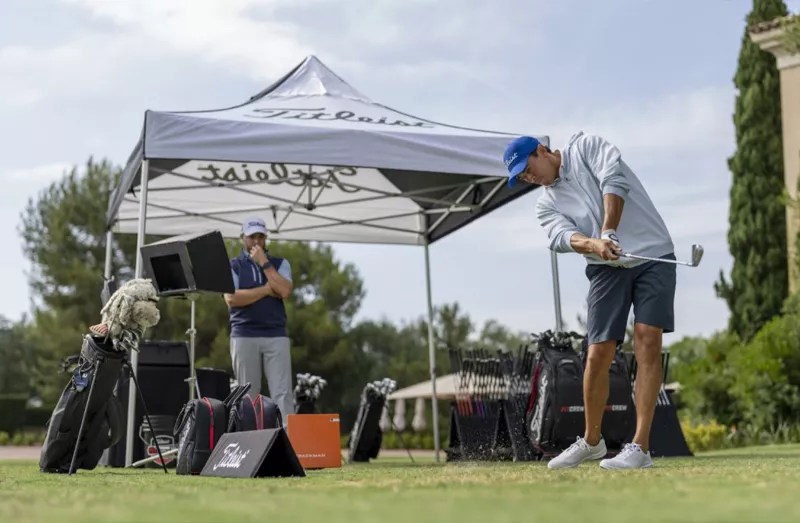
So you’ve never been to a fitting in person, you know you need one but you’re nervous that you’re not sure what to expect, this is the article for you. I’ve fit hundreds of players myself, watched thousands with some of the best fitters, and unfortunately with all of the different manufacturer demo days I’ve assisted with I’ve also worked with a handful of fitters not as armed with the proper knowledge. Over the next few paragraphs we’re going to lay out what a good fitting looks like, what to bring with you and what to expect from the process, and I think just as importantly what a bad fitting can look like. First and foremost, just a reminder of the best places to go from our Fitting Friday a few weeks ago. The best places to go, in my opinion, and especially if you have your brand already narrowed down is to a green grass golf shop (whoa that’s like our brand name…) at a local golf course or country club. Do a tiny bit of research, call around, if you want Titleist clubs, find a local Head Pro or Director of Instruction on Titleist staff, same with Taylormade, Callaway, Ping, whomever you want to make your clubs for you, find a local pro on that staff. These golf pros are not given these clubs for free just to sell them, I can tell you from experience they are also given a lot of training with each new club that is released. They all test those new clubs, they hit them all and fit themselves or each other before they come out, they take online courses and attend presentations on new lines of irons and metals, are trained by the manufacturer on how the clubs work before they are released. This is the best way to do it if you are a brand loyalist like most of the golfers I’ve met are these days, but what if you haven’t narrowed that down? Most of the areas that I’ve lived have golf retail locations, and these are certainly not anything I recommend against (unless you just walk in trying to fit yourself…) as long as you schedule a fitting with one of their senior fitting professionals. If you can find it, a lot of local driving range facilities have the same setup with a golf pro not on any single brand staff, a retail space selling clubs from a lot of different manufacturers. You need someone there who is trained on ideal launch angles, spin rates, smash factor, and max distances for a swing based on all of those factors. The only place I recommend vehemently against is Club Champion, and I’ll tell anyone who will listen. The absolute greediest fitting center in the business, they are not only making you pay simply for the experience of hitting all their exotic shaft offerings, they are doing much worse. There are a ton of good fitters there, I’m not saying that they don’t know what they are talking about and you are getting clubs that won’t work, but they are trained to be salespeople FIRST AND FOREMOST. On top of the hundreds they charge just to walk in the door, they are trained to fit you into the most expensive upcharge exotic shaft that most closely fits your swing. I was told when I interviewed with them in no uncertain terms that I needed to be comfortable up-selling and pushing golfers toward the most expensive shaft that most closely fits their swing. They are trained to LIE to you, and tell you a more expensive shaft might be better even if the numbers tell them a “stock” shaft produces better results. This absolutely appalling practice should be avoided by all golfers at all costs.
That is an example of what a bad fitting can look like, having a fitter that has you hit only the most expensive exotic shaft offerings. Another way a bad fitting can show itself is without proper equipment, like trying to fit in a simulator bay instead of with a proper Flightscope or Trackman radar launch monitor. Or even with just a lack of shaft selections, and that’s not to say you need a regular, stiff and X flex in every shaft a manufacturer is offering. A good fitter will generally have at least one of most offerings in the most common flex, something from each shaft manufacturer, the most common shafts in multiple flexes and lengths, if your fitter only has you hitting a few shafts from a single manufacturer that doesn’t guarantee the best results for you. A bad fitting will also not fit you for things like length and lie angle, not go over grip options and let you test a few of those out in your hands with a few un-installed grips. You don’t need to hit clubs with different grips for a good fitting, that is a lot to ask of a fitting professional to have all the different grips to test on their fitting shafts, but having loose grips to feel is generally essential if you don’t know what you are looking for.
This is what a good fitting should look like, and for this to work all you need to bring is the clubs that are getting replaced. The most important part of the fitting can just be that you bring your 7 iron to hit versus the iron fitting heads that you’ll be testing out. If I only learned one thing from being a golf professional, it’s that no golfer can feel all of the intricacies of their golf swing mechanics. If you’ve never hit on a launch monitor, I promise you can’t tell me your exact swing speed with your 7 iron, you don’t know your exact angle of attack, ball speed, launch angle, or spin rate. You may not even be correct with exactly how far you hit it at sea level with no wind or elevation changes, the way a launch monitor will read your ball flight, because you’ve never played on a golf course without wind or elevation changes. You may think you hit your 7 iron 175 because that’s what you hit on the 175 yard par 3 at your golf course, when actually that prevailing wind is generally helping more than you realize, that hole is more downhill than you realize, your stock carry distance might be 155 with that club. That means if you don’t bring that with you, see that for yourself, then try to test 7 irons going 160-165, even if that is better than your current 7 iron, you don’t think so because you think you hit your 7 well over 170 yards on the course most of the time. Very, VERY rarely (I’d say likely never) are any of us ever going to have a perfectly flat shot, no wind or atmospheric factors affecting distance, so not hitting on a launch monitor that tells you EXACTLY how far your shot goes compared to what you are being fit for makes it incredibly difficult to dial in stock distances the way we need them in a fitting setting. So you have your clubs with you, your first 10-15 swings to get loose and groove in your swing should always be with your current clubs. You’ll arrive to your fitting, and your fitting professional will observe your swing and ball mechanics with your current clubs. Not only does this give them a good idea of where to start with the fitting, what shafts and heads to start testing first, it also tells us what we need to beat. If you are striping your driver 300 down the middle with very little directional misses, and you test out every head and shaft combo to max out at 290-95, a good fitter will recommend you leave without making a purchase. If a new club will not perform better than your current gamer, a proper fitting should have you leaving with no new gear. Good fitters, fitting professionals who are not trained to up-sell or make commissions on their fits will recommend you go with the club you hit better whether that is a new club or not. If that is not the case, that is a bad fitting, it would behoove you to seek another professional in your area or just leave without making a purchase on your own.
A good fitting professional will have you test multiple shafts and heads, rather than making their recommendation based on the first shaft they think you should test. Just because a shaft and head feels good, doesn’t mean another can’t feel even better. After hitting your current clubs, you should be able to test a variety of different heads and shafts in different lofts and styles. Then just as important as the shaft and head selection itself should be fitting for length, loft, lie adjustments. Testing different lengths of shaft, hitting with different hosel settings, hitting on lie boards with lie board tape on the club to test where you’re making contact with the ground, this like this are essential to do in your golf setup and swing. You can’t use wrist to ground measurements or standing height or anything like that outside of your golf setup or swing. Your height doesn’t tell us how far you bend over in your setup or at impact, static measurements don’t tell us where your hands come from, where they are at setup or impact relative to the ground, therefore they can’t tell you what your length and lie should be. So to recap, your good fitting should look like this: 1.) Warm up with your current gamers 2.) Test a WIDE VARIETY of heads and shafts 3.) Test in depth for length, lie adjustments, and finally 4.) Test different grips, grip sizes, materials, with actual grips in your hands.
And finally as a P.S…a good fitting does not say you need to hit every single iron head from PW to 4 iron to dial in your distances for each iron with micro-loft adjustments. If you can’t hit your 6 iron 20-30 yards further than your 8 iron the best thing you can do for yourself is make adjustments to the way you set up and swing with your 6 iron to correct that. The gentlemen and ladies on the Professional Tours do not hit and fit with each iron to dial in exact distances they need to hit, that is what the club making process is designed to do. Golf clubs are designed and produced after YEARS of research and development, including extensive testing as to what the exact lofts should be for those iron heads they designed. If you are fit for a set of irons using only the 7 irons for various heads, and find that your 5 iron you were professionally fit for is only going 5y further than your 7 iron, I can promise you 999 times out of 1,000 that has nothing to do with the design of the club. Also that 1 time it’s not to do with the loft with which the clubs were designed either, that 5 iron is just broken or wasn’t assembled properly and needs to be replaced. Your irons were not designed improperly, they weren’t researched and developed incorrectly for years behind the scenes using thousands of test swings from golfers of different skill levels on top of robot testing with an Iron Byron. I promise you can fix your yardage gaps in those cases with very small adjustments to your setup and swing, don’t kill yourself trying to find a fitter that doesn’t exist!

 Green Grass Golf Shop
Leave a comment