
Even thinking about it for just a second, most of us understand that the putter is the only club you’re almost guaranteed to use every hole. When you think about it further, even other clubs you think you use the most, like most of us with our drivers or wedges, pale in comparison to the number of times we use out putter in a given round. Even a really high level putter is taking 26-30 putts in a good round, twice as much as a driver or your highest lofted wedge that some of you are thinking you use just as much. Most of us aren’t hitting our driver on all 18 holes with the par 3’s out there, and if you’re playing to shoot a score, you shouldn’t even be using your 60 every single chip shot around the green. However unless you chip in from off the green, you’re using your putter at least once, if not 2 or more times on most holes. With this being the case it’s always baffled me how people scoff at $350 dollar putters as they drool over the newest $500+ drivers that you can’t even use every hole. With that being said it’s easy to get yourself a putter that doesn’t fit your natural motion, so here are some FAQ’s and advice on picking the right flat stick for your game!
1.) What’s the biggest difference between all these different putters? The biggest difference between all the different putters out there is definitely the neck, or hosel style of the putter and how that changes the angle of the shaft into the putter head. Below we have an illustration here from the Scotty Cameron site explaining what I mean by that:
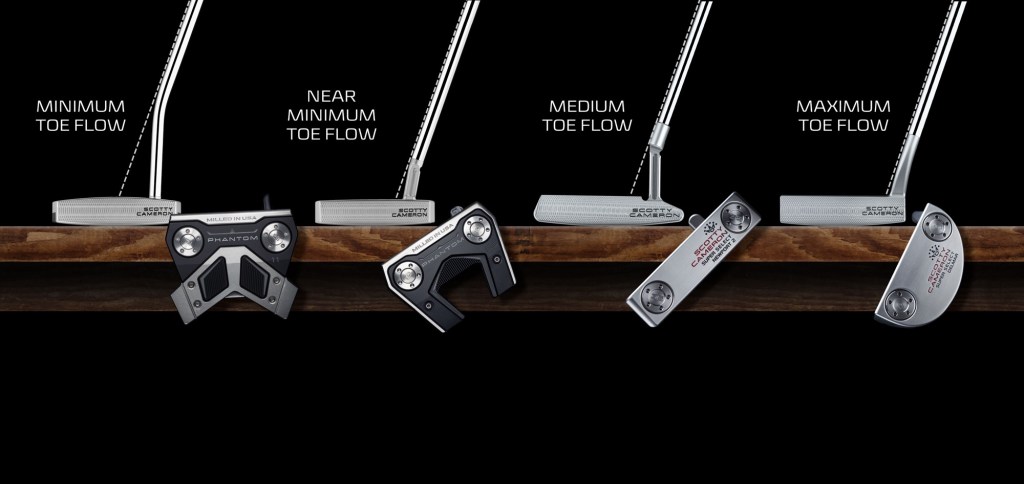
As illustrated, the angle at which the shaft is going into the putter head has a massive influence on how the putter will travel through the stroke. The closer that shaft angles toward the heel of the putter head, the more that toe will flow, or in layman’s terms the more that face will want to naturally shut during the putting stroke. That means if you have a straight back and through stroke and just go out and get a putter that has the shaft angled right into the heel like the putter above on the far right (like I’ve done before…) you’re gonna have a bad time. Very similar to a french fry when you pizza, you’re gonna have a bad time. The shape of the putter can influence this a little as well, but in my experience never nearly as much as the shaft angle. Learn the shape of your natural putting stroke, and make sure you match that to your next new putter if you want to make sure you get a putter with which you can actually make more putts!
2.) What’s the difference between a blade and mallet style putter? The idea I hear the most about the relationship between blades and mallet putters is that blades are more accurate, mallets are more forgiving. The thought it that blades are easier to line up, and it’s very true that most mallets are much more consistent with distance on off-center strikes. This idea in my opinion is only half-true, and again like most beliefs in the golf industry, pretty outdated with how rapidly the technology in the golf industry has exploded the last few decades. First and foremost with putting, distance control plays a ton into accuracy, if for no other reason than it’s a hell of a lot easier to hit a putt 10ft long or short than it is to miss it 10ft left or right. For that reason alone I think mallets are both more forgiving and more accurate, but the idea that they are harder to line up is also outdated with the better understanding we now have of how different lines, dots, angles and combinations of those things can actually help certain people line up a putter more consistently. In my professional opinion, almost all players should be playing more mallet style putters, as long as they can find a style that fits their eye and they can line up with the same consistency they could with a blade. The only reason I see players with blades in their bags is to try to mimic the professional players (namely Tiger) they see on TV, thinking if they are a better putter, they should be playing a smaller head with more accuracy or something along those lines. So essentially in short, what I see the biggest difference being is that blades are only less forgiving on off-center hits, provide poor distance control compared to mallet style putters, the blade just looks better still to a lot of golfers.
3.) Will a bigger putter grip make me a better putter? Just putting a bigger grip on your putter will not automatically make it easier to make putts or keep your putter more stable, it won’t quiet your hands all by itself. Now having said that, if you struggle with the smaller standard pistol grip being unable to grip such a smaller size handle in your palms for some reason or another, it could help. If you find your hands in your putting grip migrating more toward your full swing grip, unable to easily remedy that, a larger putting grip and moving your hands closer to level rather than one being lower like your full swing grip can make that easier. With that position and the grip more in the hands than your fingers, in theory, that can help quiet the rotation in your motion if you find you have excess. No, pulling the ball left does not automatically mean than your hands are too active or your grip is too large. That can certainly also come down to the shape of the putter, the shaft and hosel position and style like we talked about earlier, lifting your head too early or poor body mechanics. So circling back to where we started answering this question, no, simply putting a larger grip on your putter does not automatically quiet your hands or make you a better putter, there are far too many other factors at play!

 Green Grass Golf Shop
Leave a comment